Guide to how to make a commercials: A Production Blueprint for Impact Ads
Learn how to make a commercials with a practical, step-by-step approach, from strategy to distribution, that boosts ad performance.
It’s easy to get excited about the creative side of making a commercial—the cool shots, the funny lines, the perfect song. But jumping into production without a clear strategy is a recipe for a commercial that looks great but does absolutely nothing for your business.
Before you even think about cameras or scripts, you have to lay the groundwork.
Building Your Commercial’s Winning Strategy
Every truly successful ad starts with a rock-solid plan. This isn't about guesswork; it's about being brutally honest about why you’re making this ad and who you’re making it for. This foundation is what separates a memorable commercial from forgettable noise.
Pinpoint Your Core Objective
First things first: what is the one thing you need this commercial to do? An ad without a clear goal is just expensive art. Are you trying to drive immediate sales for a new product launch? Build up your brand’s reputation? Or maybe you just need to fill your sales pipeline with qualified leads.
Each of those goals demands a completely different creative angle. A sales-focused ad needs a sense of urgency, maybe a limited-time offer with a strong call-to-action. A brand awareness piece, on the other hand, might lean into an emotional story that builds a deeper connection with your audience.
Key Takeaway: Your objective is your compass. It dictates everything from the script to the metrics you use to see if it even worked. Get specific. "Increase sales" is a wish. "Increase online sales of our new sneaker by 15% in Q3" is a goal.
Define Your Target Audience
Next, you need to know your audience inside and out—and I mean way beyond basic demographics. It’s time to build a real persona. What are their actual pain points? What makes them stop scrolling through Instagram or TikTok and pay attention?
To get a clearer picture, ask yourself:
- What daily frustrations does my product or service actually solve for them?
- What’s their sense of humor like? Do they respond to heartfelt stories or witty one-liners?
- Where do they hang out online, and when are they most active?
When you understand their world, you can craft a message that doesn’t just get seen, it gets felt.
Craft a Compelling Core Message
Once you have your objective and audience locked in, you can finally figure out your core message. This is your unique value proposition boiled down to a single, powerful idea you want viewers to remember. It has to be simple, memorable, and speak directly to their needs.
Getting this strategic groundwork right is what turns a vague concept into a targeted plan for an ad that actually delivers. If you want to dig deeper into the entire process, this practical guide on how to make a commercial is a great resource. It’s this initial planning that ensures your creative effort translates into real business impact.
Scripting and Storyboarding Your Big Idea
 With your strategy locked in, it’s time to get that vision down on paper. A strong script is the absolute backbone of your commercial, but don't overthink it. Some of the most effective ads I’ve ever seen follow a dead-simple structure that pulls the viewer in and pushes them toward action.
Think of your script as a mini-story with a beginning, a middle, and an end: the hook, the problem/solution, and the call-to-action (CTA). This classic framework is your best bet for delivering a clear, impactful message without wasting a single second of your audience's time.
The opening is everything. You have maybe three seconds to stop someone's thumb from scrolling past your ad. That's it. On social media, where you're fighting for every scrap of attention, a killer hook can be a punchy question, a weird visual, or a problem they know all too well.
Structuring Your Commercial Script
A tight, well-structured script is your map during production. It keeps everyone on the same page and ensures your message stays sharp. This isn't about writing a Hollywood screenplay; it's about clarity.
- The Hook (Seconds 1-3): Go for the jugular. If you're selling a cleaning product, show the absolute worst "before" shot immediately. For a software tool, hit them with a question that speaks directly to their biggest frustration.
- The Problem/Solution (Seconds 4-12): This is the core of it. Show the struggle, then BAM—introduce your product as the hero. Focus on demonstrating its value and making the solution look effortless, not just listing off features.
- The Call-to-Action (Seconds 13-15): End with a crystal-clear, impossible-to-misunderstand instruction. "Shop Now," "Learn More," or "Download Free." Leave no doubt about what you want them to do next.
This isn't just a hunch; the data backs it up. Short-form ads under 15 seconds now capture 66% of global consumer attention online. To really nail this, our guide on writing a great script for an advertisement has a ton of extra examples.
From Words to Visuals with Storyboarding
Once the script feels solid, you have to see it. That's where storyboarding comes in, and skipping this step is one of the biggest mistakes small teams make. A storyboard is just a sequence of simple drawings or images that maps out each shot.
Honestly, even terrible stick figures can save you a mountain of time and money. It helps you and your team agree on the visual flow, camera angles, and pacing before you ever touch a camera. You’ll instantly spot awkward transitions or shots that don’t quite land the way you imagined. It’s your visual blueprint.
Pro Tip: Your storyboard does not need to be a masterpiece. I've used rough sketches, stock photos, and even AI image generators to quickly mock up scenes. The goal is communication, not artistic perfection.
If you want to get better at planning your visuals, exploring different storyboarding techniques for explainer videos can provide some fantastic insights. With a great script and a clear storyboard, you’ve laid the foundation for a much smoother production.
Choosing Your Production Method: Live Action vs. AI Video
Okay, you’ve got your plan and storyboard locked in. Now comes the big decision: how are you actually going to make this thing? This is a real fork in the road, with two main paths to a finished commercial. You can go with a classic live-action shoot or embrace the newer, faster world of AI-powered video creation. Each has its place, and the right choice depends entirely on your goals, timeline, and budget.
The traditional live-action shoot has an authenticity that’s tough to beat. If your ad depends on genuine human emotion, nuanced performances, or showing off a physical product in a real-world setting, this is almost always the way to go.
But let's be honest, it's a huge logistical undertaking. You're talking about coordinating a crew, renting pricey gear, scouting locations, and juggling everyone's schedules. For smaller teams or marketers who need to move fast, those moving parts can make budgets and timelines explode.
The Rise of AI-Powered Commercials
This is where AI video platforms are changing the game, especially for lean marketing teams and startups. These tools are built for speed. They let you take assets you already have—like product photos, logos, or even stock footage—and spin them into polished, cinematic ads. The entire headache of a physical shoot just… disappears.
This approach is a godsend for creating content at scale. Imagine you need to showcase an entire e-commerce collection or test ten different ad variations on social media. With AI, you can crank out a high-quality video in minutes, not weeks. That means you can finally react to market trends or launch campaigns at the speed of thought.
Key Takeaway: A live-action shoot is your best bet for capturing genuine human emotion and detailed physical interactions. An AI-powered approach, on the other hand, wins on speed, cost, and scalability, making it perfect for agile, digital-first advertising.
Comparing Production Methods: Live Action vs. AI-Powered
To make this choice clearer, let's break down the key differences between a traditional production and using an AI tool like Proom AI. This side-by-side comparison should help you see which path aligns best with your project's needs.
| Factor | Live-Action Shoot | AI-Powered Video (e.g., Proom AI) |
|---|---|---|
| Cost | High (crew, gear, locations, talent) | Low (often a subscription or credit fee) |
| Speed | Slow (weeks to months for planning, shooting, and editing) | Extremely Fast (minutes to hours from assets to final video) |
| Flexibility | Low (reshoots are expensive and time-consuming) | High (easily create dozens of variations for A/B testing) |
| Authenticity | Very High (captures real human performance and environments) | Varies (best for showcasing products and concepts visually) |
| Complexity | High (requires coordination of many people and resources) | Low (intuitive interface, often just a few clicks) |
| Scalability | Difficult (each new video is a major new project) | Easy (produce unlimited versions from the same set of assets) |
As you can see, the decision isn't about which method is "better" in a vacuum, but which is the smarter choice for your specific campaign, resources, and strategic goals.
Ready to create video ads?
Turn your photos into scroll-stopping ads in minutes. No video editing skills required.
Try For FreeMaking the Right Choice for Your Campaign
So, how do you decide which path to take when learning how to make a commercial? It really boils down to asking a few honest questions about your project.
- Is a human performance essential? If your concept lives or dies on an actor’s delivery or a heartfelt testimonial, you probably need to go with live-action.
- What’s your real budget? AI video production can slash costs by over 90% compared to a traditional shoot. No crew, no gear rentals, no location fees. The savings are massive.
- How fast do you need it? If the deadline is tight, it’s no contest. AI can deliver a finished ad in a fraction of the time, turning projects around in hours instead of weeks.
- Do you need to create many versions? For A/B testing different hooks or targeting various audiences, AI is a powerhouse. You can generate tons of variations from the same assets with minimal effort.
Getting familiar with the tools out there is also a critical step. For anyone weighing their options, diving into a detailed video production software comparison can be incredibly revealing. It will help you see what different platforms offer and find the one that fits perfectly with your workflow. Ultimately, the best method is the one that lines up with your resources and helps you hit your goals.
Post-Production: Where the Real Magic Happens
The shoot is wrapped, or your AI tool has worked its magic. Now for the fun part: post-production. This is where you take all your raw footage and assets and stitch them together into a polished, professional commercial. Think of it as the final assembly line where the story truly comes alive.
Your first step is the initial cut, often called the assembly edit. You’ll be arranging all your video clips or generated scenes to follow the storyboard you created earlier. The goal here is to build a narrative that flows naturally and to get the pacing just right. You'll trim the fat, tighten up transitions, and make sure every single second serves a purpose.
Crafting the Perfect Auditory Experience
With the visual flow roughed in, it’s time to focus on sound. Don't underestimate this step—audio is easily half the experience, and getting it right is the difference between a commercial that connects and one that falls flat.
- Background Music: The right track sets the mood in an instant. Is your ad high-energy and exciting, or is it more emotional and thoughtful? Most modern video platforms and editing tools have massive libraries of licensed music, making this part easier than ever.
- Sound Effects (SFX): Little sounds—a crisp click, a smooth whoosh, a subtle ding—make your visuals feel more real and satisfying. Just use them strategically to highlight key moments without overdoing it.
- Voiceover: A clear, well-recorded voiceover guides the viewer through the story. And now, with AI voice generators, you can create incredibly crisp voiceovers in dozens of languages, opening up your ad to a global audience.
This chart can help you visualize how your production choices influence what your post-production workflow will look like.
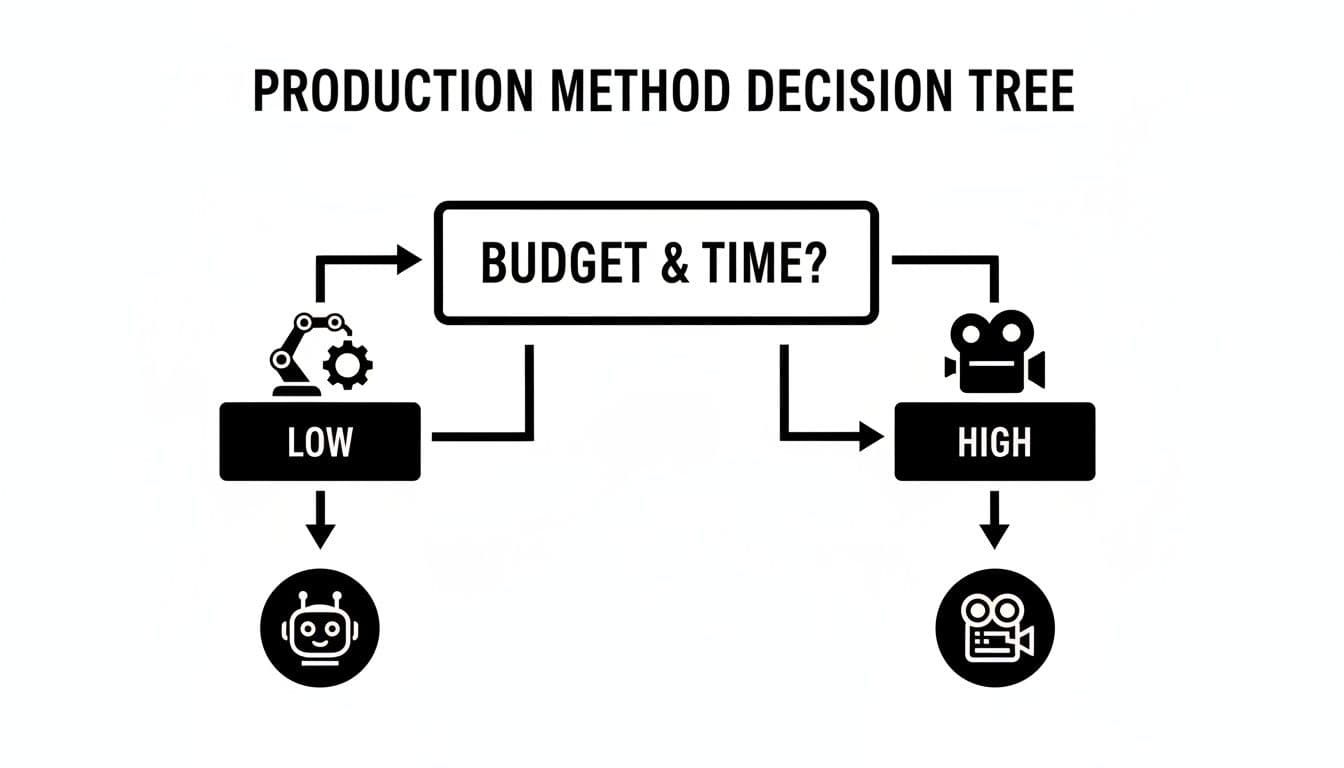
Whether you went with a big-budget live shoot or a more nimble, AI-driven approach will really dictate the tools and time you’ll need to allocate here.
Adding That Final Visual Polish
The last layer is all about the visual details that give your commercial that professional sheen. One of the most powerful tools in your arsenal is color grading. This is where you adjust and enhance the colors to create a specific cinematic look that matches your brand’s personality.
Next up are your text overlays and captions. This is non-negotiable. They reinforce your main message, spell out your call-to-action, and make your ad accessible to the huge number of people who watch videos with the sound off. In fact, combining music, great visuals, and clear captions can lead to an 80% boost in brand recall. We've also seen that since 2019, AI-enhanced ads have seen video completion rates jump by an average of 35%, largely thanks to dynamic elements like multilingual voiceovers. You can dive deeper into how production trends are evolving to see where things are headed.
The Final Polish Checklist: Before you hit "export," do one last pass. Is the branding consistent? Is the audio mix balanced (you don't want the music drowning out the voiceover)? Is your call-to-action crystal clear and easy to see? This final check ensures every element is working together perfectly.
Launching and Optimizing Your Video Ad Campaign
You've done it. The video is polished, approved, and ready to go. Now comes the real test: getting it in front of the right people.
Launching a video ad isn't a simple matter of hitting "publish." Every platform, from the fast-paced, vertical world of TikTok to the more traditional landscape of YouTube, operates by its own unwritten rules and audience expectations. Nail these, and you're golden. Get them wrong, and you're just wasting money.
The first hurdle is always the technical stuff. Getting your video’s aspect ratio right—like a vertical 9:16 for Instagram Stories versus a widescreen 16:9 for YouTube—is completely non-negotiable. It might seem small, but using the wrong format is the quickest way to look like an amateur and kill your campaign before it even has a chance to breathe.
Mastering Platform Specifications
Think of each social channel as a different country with its own language and customs. To connect, you have to speak their language. The same ad just won't work everywhere.
Here’s a quick rundown of what you need to know for the major players:
- Meta (Facebook & Instagram): Square (1:1) and vertical (4:5) are your best bets for the main feed. For Stories and Reels, it's 9:16 or nothing. Your goal is to grab attention instantly and deliver your message fast.
- YouTube: The classic 16:9 format reigns supreme here. You’ll be dealing with skippable in-stream ads (where those first five seconds are everything) or shorter non-skippable ads for a quick, punchy message.
- TikTok: Welcome to the 9:16 vertical universe. Your ads absolutely must feel native to the platform. That means authentic, maybe a little raw, and often leaning into trending sounds or effects. A slick, corporate-style video will stick out like a sore thumb—and not in a good way.
Beyond the video itself, you need a headline that stops the scroll and ad copy that pulls people in. Your video could be a masterpiece, but a boring headline ensures nobody will ever click play. Write copy that sparks a little curiosity or hits on a pain point your audience is feeling.
The Power of Continuous Optimization
So many marketers fall into the "set it and forget it" trap. They launch a campaign, cross their fingers, and walk away. That's a huge mistake.
The real secret to a killer campaign is relentless A/B testing.
This is where you create a few different versions of your ad to see what actually resonates with your audience. Test different hooks in the first three seconds. Try out different visuals. Swap the call-to-action (CTA) button. You'd be amazed how a tiny tweak can lead to a massive improvement in performance. For a closer look at what works, check out our guide on how to create video ads that convert.
Did you know that video ads have skyrocketed in effectiveness? They drive 80% more engagement than static images alone. In key markets, videos boast a 25% higher click-through rate (CTR) than standard display ads. And for platforms where attention is fleeting, videos under two minutes retain 85% of their viewers.
The launch is just the starting line. By constantly testing, analyzing the data, and refining your approach, you turn a good campaign into a great one. This iterative process makes sure your ad spend is working as hard as it can to get you the best possible return.
Got Questions About Making a Commercial?
Even with the best game plan, jumping into video production for the first time always brings up a few questions. Let's tackle some of the most common ones that marketers and business owners run into when they're figuring out how to make a commercial that actually works.
I've broken down everything from costs and timelines to getting the most out of a shoestring budget, all based on real-world experience.
How Much Does It Cost to Make a Commercial?
This is the classic "it depends" answer, but today, that range is bigger than ever. On one end, a traditional live-action shoot can run you anywhere from a couple of thousand dollars for a simple local spot to $500,000+ for a national campaign with a full crew, actors, and location fees. It adds up fast.
On the other end of the spectrum? An AI video generator can bring that cost down to almost nothing. Using a tool like Proom AI, you can spin up a high-quality, professional-looking video ad for less than a hundred bucks, often just by using the product photos you already have.
The Bottom Line: Traditional shoots can range from $2,000 to $500,000+. AI-powered production, however, can cost less than $100 per video. It’s a game-changer for small businesses and startups.
How Long Should a Commercial Be?
The golden rule here is to let the platform dictate the length. People's attention spans are brutally short, so you have to be efficient.
- Social Media (TikTok, Instagram Reels): You’ve got 15 seconds, tops. The goal is a lightning-fast hook and a clear message before they swipe.
- YouTube Pre-Roll Ads: The dreaded "Skip Ad" button appears in 5 seconds. Your opening has to be magnetic enough to convince them not to click. The full ad can then run 15-30 seconds.
- Television or Connected TV: Here, you have a bit more breathing room. The 30-second and 60-second spots are standard, which gives you enough time to tell a real story and build an emotional connection.
My advice? Always start with the shortest version you need. It’s far easier to build on a tight, punchy script than it is to chop a longer one down without losing the magic.
Can I Really Make a Commercial with My Phone?
Absolutely. And you probably should. Modern smartphone cameras are ridiculously good, and for certain ads, they’re the perfect tool. A commercial shot on a phone feels authentic and native to social media, where overly polished ads can stick out like a sore thumb.
But there are two non-negotiables: good lighting and clear audio. You don't need a Hollywood budget. A simple ring light and a cheap external microphone will make your phone footage look and sound ten times more professional. That small investment pays for itself instantly.
What Is the Single Most Important Part of a Commercial?
Every piece of the puzzle matters, but if I had to pick one, it's the script. More specifically, the first three seconds of it.
If your hook doesn't stop the scroll and grab someone's attention immediately, the rest of your beautifully crafted ad is worthless because no one will stick around to see it. A killer opening creates curiosity, hits on a relatable problem, or shows off a visual so stunning it forces them to pause. Get that right, and everything else falls into place.
How Can I Make a Great Commercial on a Tight Budget?
Working with a small budget isn't a limitation; it's a creative challenge that often produces the best ideas. You just have to be resourceful.
- Use an AI Video Generator: This is the biggest money-saver, period. It cuts out the need for a film crew, expensive equipment rentals, location scouting, and actors.
- Lean into User-Generated Content (UGC): Ask your happy customers for video testimonials or clips of them using your product. UGC is authentic, builds massive trust, and is completely free.
- Keep It Simple: Don't try to cram three different ideas into one ad. Focus on a single, crystal-clear message. A simple concept executed well will always outperform a complex one that's poorly produced because you ran out of cash.
- Tap into Stock Resources: Use royalty-free music, stock video clips, and sound effects to give your ad that professional sheen without the professional price tag.
Making a commercial on a budget comes down to making smart choices. Put your limited resources where they count the most: a brilliant script and a can't-miss call-to-action.
Ready to create stunning video ads in minutes, without the crazy cost and complexity of a traditional shoot? Proom AI turns your product photos into cinematic commercials with just a few clicks. Choose a template, upload your images, and let our AI do the heavy lifting. Start your free trial today and see how easy it is to make a commercial with Proom AI.
Ready to create video ads?
Turn your photos into scroll-stopping ads in minutes. No video editing skills required.
Try For FreeStay ahead in video marketing
Join thousands of marketers getting actionable insights delivered to their inbox.
Join 5,000+ marketers. No spam, unsubscribe anytime.